REVIEW: ‘Fourth & Walnut’ by Jeremy Over
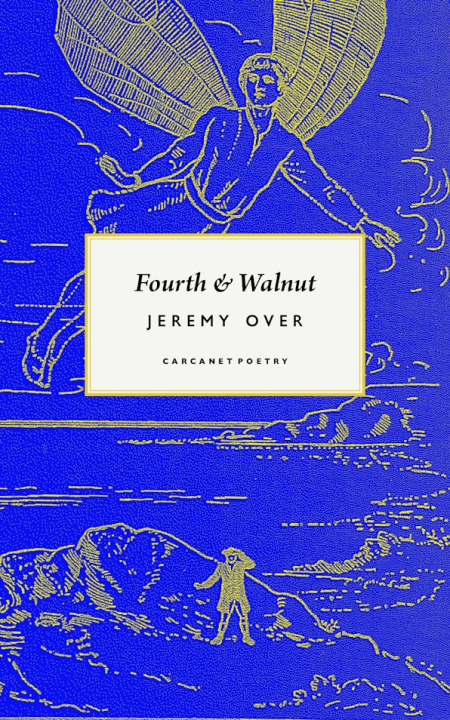
Fourth & Walnut Jeremy Over (Carcanet, £12.99)
Ah, words! Don’t you love them? Jeremy Over does. Silence and its thoughts too, its imaginative wanderings in which words fill spaces. He plays with words, even when they belong to others. One might call his playfulness ‘linguistic subversion’. He has fun with Rilke, not an easy cove to have fun with. He quotes Rilke’s Letters to a Young Poet and the reply of the Young Poet himself (Franz Kappus), who will remain mute in awe of the ‘great and unique soul’ even, one suspects, when it’s spouting oracular nonsense. Ah, the irony of opting for silence when a great soul is urging you to speak; or not! Over’s address to the Small Ones such as Kappus is to be careful with Rilke and his ilk, and, when perplexed, hasten and listen to someone else – US poet James Broughton (or perhaps Ted Shawn or the Grateful Dead), who advised ‘when in doubt, twirl’. Or Gaston Bachelard, Friederike Mayröcker, Gertrude Stein, Henry Miller; and William Blake, before Over has ‘trampled’ on his deathbed song to his wife. A whole legion blanket-namedropped in three pages, including, at the end, the mystic Thomas Merton, who on the intersection of the eponymous ‘Fourth and Walnut’ in a Kentucky shopping precinct beheld the epiphany of discovering the fraudulence of self-isolation. But words failed him: there was no way of telling people that, as he was, they were all ‘shining like the sun’. Thomas Merton, too: not an easy cove to have fun with.
Bachelard, also addressed, is the French philosopher who believed that no space was too vast or too small to be filled with thoughts and reveries. ‘Equinox in a Box’, is a twenty-five page poem about Over’s occupation of two such spaces, each from dawn to dusk and one (relatively) vast and the other (relatively) small: a solo retreat in the Cairngorms and the inside of sculptor James Turrell’s Deershelter Skyspace in the Yorkshire Sculpture Park, a conceptual work offering the enclosed viewer a ceiling patch of sky to watch and contemplate. The mind wanders:
On the concrete floor there is the dark outline of a rect-
angle burned into it corresponding to the aperture in the
ceiling where Yorkshire rain has dripped down from its
edges all winter.
And:
On the way here I follow a deer and a stonechat.
I ask a wren if this is where he hides out
and he promptly vanishes.
And:
The rectangle on the diagonal now and thus a diamond.
“The black triangle in the window represents the Eiffel
Tower”.
The last observation here, after less than an hour ensconced, purports to be someone describing a painting by Joan Miro. Can a skyscape be that interesting? Mind-wandering encompasses Turrell himself, as it might, as well as the Dubliners, artist Jim Dine, footballer / commentator Jimmy Hill, and Mini-cheddars, Wotsits etc., etc. (Oh, praise ye the demotic, the low culture / high culture bob-bobbing.) Here, we have literally a concept within a concept: an Over concept stuffed with named creatives inside Turrell’s over-arching sculptural concept, but the complexity soon has the reader looking for poetry, something poetic, to match the conceptual convolution:
Midges bubble up and down in the shafts of sunlight. What are
they doing? Dancing? Feeding? Making themselves attractive?
Do we care? Over does, to the extent of nailing the matter with reference to a (mock?) scientific journal suggesting that ‘mating in a viscous universe’ will be won by the agile not the swift. Well, there you go. Oh, and Kornei (Korney) Chukovsky, the Russian children’s poet akin to America’s Dr Seuss, joins the luminaries. Of course, there are other, more profound musings:
It’s near a quarter to seven
And there’s no one in the place except heaven
No you and no me
Is it the heaven for which the gazer Merton fixed the coordinates? And then there’s Ronald Blythe’s coda, lamenting the inability of adults to see giants and elephants figured in the clouds, as they did when children. Is that what’s going on – the reduction of the authoritatively complex to a common enough desideratum?
We could do with more of the moving sentiment of ‘In The Middle of Things’, but the collection is swiftly into ‘Reading in the Rain: An Essay’, a lengthy riff on a quote from Frank Smith’s psycho-linguistic Understanding Reading and his view that our lives are based on prediction and on our surprise when it fails. ‘Reading in the Rain’ bristles with surprises, not least the appearance of ‘Anglo-Polish meteorologist’ Tomasz Schafernaker (BBC weatherman, to you) and Angela Rippon, who needs no introduction, as they say. Merton re-appears; Turrell, too, who has ‘kindly raised’ the ceiling from his skyspace so that in looking we may be lifted up and healed. ‘Reading in the Rain’ is a masterpiece of intellectual trawling and the surreal. We can’t get away from the sky hole, nor are we supposed to.
The final 24 pages are pure surrealism, being the defaced folios of of an illustrated book by WT Stead for young people called Eyes and No Eyes (or The Art of Seeing), the main title part-erased to give the Joycean ‘Yes and Yes’ of Over’s title and the text interfered with to create so-called ‘found’ poetry. It barely works in rational terms but it’s not supposed to: surreal is weird, its disturbing element the surprise that jolts the predictable, like a fur-covered cup and saucer. But are Merton’s co-ordinates to be found there? Maybe.
On the surface, the collage of Fourth & Walnut offers the oxymoron of serious whimsy. The trouble with such incongruity here is that it strains after the special effect. And what of Thomas Merton, seriously awestruck outside the Louisville shops? Self-isolation is no less a chimera than the uniform (and desired) sunshine of his epiphany; indeed, it has the cachet of a philosophical movement, however much derided.
Fourth & Walnut’s lightness and wit emerge from multi-provenanced authority; they also beg a question about the nature of contemporary poetry, and its duty to eschew cleverness, as appearance or reality. Ah, words! ‘They can be taught to do anything’.*
(* S J Perelman, Judge magazine, 1954)
Nigel Jarrett is a winner of the Rhys Davies Prize for short fiction. His latest poetry collection, Gwyriad, is published by Cockatrice.