
Books of the Year 2025 / Part Two
Contributors to The Lonely Crowd choose the books they have most enjoyed this year. Part Three follows on Friday.
Karys Frank
Sarah Hall’s Helm, a gale of a novel in which the Helm wind is personified in a bold, non-linear narrative was going to be the focus of this piece. I also mulled over reviewing Moira Buffini’s Songlight. As a writer living in Cumbria, my thoughts had turned naturally to Hall’s epic work, and I’m a sucker for dystopias, so stage / screenwriter-turned-novelist Buffini’s dark YA story had me gripped. Both books deserve honourable mentions.
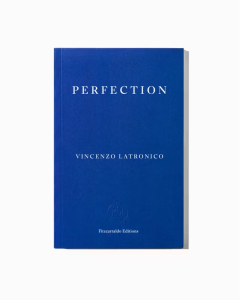
It’s Vincenzo Latronico’s Perfection (translated by Sophie Hughes), published in the distinctive electric blue cover of Fitzcarraldo Editions to which my thoughts have kept returning. This is perhaps partly because I lived in Berlin years ago and moved aimlessly for a while (while I worked out what on Earth I was doing with my life) among shoals of bewilderingly hip bohemians much like the ones in Perfection, so when reading I felt a sentiment which is a preoccupation of this book: nostalgia.
Perfection was longlisted for the International Booker and it follows nearly two decades in the lives of Anna and Tom, self-starting creatives and digital nomads who might very well have Perfection on their bookshelves, if their aching self-awareness didn’t make such a choice embarrassingly obvious.
Latronico has said he based this slim book on Georges Perec’s Things: A Story of the Sixties. Things anatomises a young couple whose identities are shaped, and ultimately made hollow, by the aesthetics and aspirations of their time, as brands begin to saturate and commodify every part of their world. This makes sense, as Latronico’s Anna and Tom are inhabitants and (through their professions) perpetuators of what journalist Kyle Chyka in 2016 termed AirSpace in an article written for US website The Verge. AirSpace describes ‘globalised sameness’. It’s the ubiquitous flattening decor of cafés, hotdesking hubs and aspirational Air BnB offerings anesthetising customers across continents into giving their credit card details. The look is of honeyed floorboards, oat-milk flat whites and lots of houseplants.
Anna and Tom are expats, (although it is not explained from where, which fits in with their restless, citizens of everywhere status) and Latronico observes the couple as if prodding specimens in a petri dish, cataloguing their actions with clinical precision. So the book can feel a little chilly. Characters have no dialogue and the story overall feels less like traditional fiction and more of a fiction-essay which takes a snapshot of a cultural moment. Sometimes their hypocrisy is funny. E.g. they refuse to use Uber, but they will if it’s snowing.
That said, the couple are not Gatsby-level social climbers nor clichés of excess. The novel redeems them by letting us glimpse their earnestness and their deep love for each other. Even if the world won’t let them be. Their satisfying sex-life is derailed by worries (fuelled by online voices) they are not doing it enough or with sufficient novelty, so a night of tender intimacy turns into a morning-after in which they feel sub-par and ‘pathetic’. The novel is also full of asides on politics (‘…they and all their friends belonged to an imprecise political left…’) social media, gentrification, and slippery ideas of what it is to be ‘authentic’.
Perfection is a satirical, strangely ambivalent novel that sits in the place where good novels live, looking at the difference between how things seem and how they are. It could make a good stocking filler for that person in your life who’s Googled ‘is fisherman core over?’ hoping fervently the answer is ‘not yet.’

My book of 2025 is Mary O’Donnell’s short story collection Walking Ghosts not only for the tales but for how O’Donnell – also a poet and a novelist – uses language with economy and precision whilst maintaining a keen sense of play throughout. While writing this piece, I finished reading Rachel Barr’s How to Make Your Brain Your Best Friend: A neuroscientist’s guide to a healthier, happier life, and immediately recognised how both Barr and O’Donnell control their texts, engaging the reader in a deep level of contemplation with an undertone of creative fun. Barr, a Neuroscientist with a background in Sports Science, in a friendly tone advocates, using scientific evidence to outline the benefits, the practice of self-compassion, movement, care and warmth towards others, and finding meaning and joy in small deeds. She urges us not to forget (without judgement) that our brains are harvesting everything we expose it to and reminds us that ’empathy is as much as for you as it is for the people you extend it to.’ She also explores what us creatives have known instinctively, that ‘creation for its own sake…allows your brain to fully explore itself.’
Curiously, the very activities Barr advocates are those that many of the people we meet in O’Donnell’s utterly engaging stories struggle to find or keep. In ‘Edna’, with its pitch-perfect pace, Edna, an older woman who, despite living in Dublin for most of her life still feels not ‘fully fledged’ in the city. She dispenses hugs and fivers to the homeless on Dublin’s streets, attempting to alleviate the pain of missing her pregnant and absent (through emigration) daughter. She tries to make sense of life and create connections through snatches of conversation. Roberta in ‘Like Queens not Criminals’ also moves alone through a city. She walks the streets of London psychologically preparing for an abortion and reassures herself ‘I do know something about beauty, how it lies in wait at the dark heart of our lives.’ Herein lies the heart of these stories.
The collection explores bodies – of people, of cities – and connections forged by movement and place. Action often pivots on moments of choice, regret, chance or surprise. Humour is rife in unexpected character pairings: ‘The Space between Louis and Me’, ‘The Stolen Man’ and ‘The Creators’ are stand out examples. In ‘Luck’, O’Donnell creates a tense atmosphere of anticipation where the simple title nods to the layered meaning in this story. Luck comes in many forms, and at the oddest times. Just like surprise – how two books read close together seem to echo a message of the importance of devoting time to creativity, believing in luck, and surprising ourselves with the stories we make and the chances we take.

The Way Beauty Comes Apart by Christina Marrocco
This novel is a literary tapestry of linked stories, an historical work of fiction told by the dead.
Christina Marrocco, from the Chicago area, delves into the depths of her Welsh ancestry, and conjures a community in the fictional North Wales townsland of Nefin, spanning 1845 to 1976. Fourteen men, women, and children—each with their own joys, secrets, and sorrows, speak from beyond the grave, their voices shaped by the cadence and colour of the Welsh tongue.
In this remote landscape of grazing sheep, yellow gorse against grey skies, winding lanes, and the constant presence of the sea, everyday life unfolds alongside the uncanny. Homes nestle among trees and hills; the local pub and capel anchor the village; and the deceased linger, some in the graveyard, others beneath their own gardens becoming part of the land they once tended.
The names alone feel like incantations: Margel Dafydd, Cranstal Jones, Crawen Priddy, Twm Gethin, Aderwen, Yolanda, Lili, Eirlys. Huw Priddy, who makes his living shifting stones from behind the farmer’s plough, unearths fossils, treasures just for him. Gwilym Jones, keeper of curios and out of date fashion magazines in his ‘Afar Shoppe’ and the two Dafydd midwives, vital to every birth and many deaths, move through the valley with the quiet authority of women who have seen the veil between worlds thin.
With the assurance of a seasoned storyteller, Marocco breathes life into each voice, guiding the reader through intimate thoughts, unspoken fears, and longings set against richly textured settings. Each tale can be savoured on its own, yet together they form a haunting, otherworldly realm—one that invites the reader to slow down, look closely, and step gently across the threshold between the living and the dead.

Persephone is a book publisher and a bookshop. Several years ago, it moved from London to Bath, where it occupies premises in the historic Edgar Buildings above Milsom Street.
Founded by Nicola Beauman, Persephone republishes and reprints neglected fiction and non-fiction, mostly by women writers and mainly from the middle of the 20th-century. So anything it resurrected this year counts as a 2025 production – or reproduction.
That one of those titles should be Crooked Cross by Sally Carson, first published in 1934, gives it topicality at a time when Trump’s America is attempting to withdraw from influencing European politics and leaving the Continent to deal with its own forms of Trumpian populism. Whereas in America right-wing politics was only ever Republican conservatism, it now has more sinister antecedents, with Democrats facing portrayal as traitors. Some say the differences in American and European political tendencies are fast diminishing.
Crooked Cross, in its 2025 manifestation, was extraordinary, even by Persephone’s standards as a business unusual in the publishing world. Written from the viewpoints of an ordinary family witnessing the rise of Nazism in Germany, its appearance under the Persephone imprint made it an immediate best-seller. It has already been translated into Italian, Hungarian, and French. One high school teacher in Texas ordered 40 copies to use in lessons about the rise of authoritarianism. Carson, from Surrey, wrote a sequel, which is also planned for re-publication. The writer and critic Rachel Joyce called Crooked Cross ‘an electrifying masterpiece’.
The Persephone story is worth investigating. Among many other forgotten writers restored to public view are Dorothy Whipple, Marghanita Laski, Lettice Cooper, Malachi Whitaker, Mollie Panter-Downes, Diana Gardner, and Enid Bagnold.

When I look back through the books I’ve read this year I don’t see many that have satisfied me. Prize-winning titles have proved disappointing, other books simply hard work. But there have been some notable exceptions.
Elizabeth Strout never disappoints me; I love her distinctive, straightforward style and the deep truth of her depictions of human relationships. Her fifth voume in the Amgash series, Tell Me Everything, brings us more of her wonderful character Olive Kitteridge, now ninety years ago and living in a retirement community but as sparky as ever, with stories to tell. It’s simply a delight to read more of her and of other characters from earlier books, including Lucy Barton, as she and Oliver end up exchanging stories of ‘unrecorded lives’.
A prize-winner that did not disappoint, far from it, was Deborah Tomkins’ Aerth, selected by Ali Smith as the joint winner of the inaugural Weatherglass Novella Prize. When the newly-discovered planet Urth to which Magnus escapes from the approaching ice-age on Aerth turns out to have its own severe limitations, he confronts difficult choices. Using the novella-in-flash form, Tomkins plays with narrative style as she takes us on the journey with Magnus. This is a book for the times in which we live, a helter-skelter ride through time and space that offers, in spite of everything, hope. It’s one I’ll re-read.
My final recommendation is Joseph O’Connor’s Mr Father’s House. It’s a long time since I’ve read a novel I haven’t wanted to put down. Based on a true story about Jewish people and escaped Allied prisoners being rescued from the Nazis in Rome in 1943, it’s a page-turner with great writing. And there’s a sequel out in paperback in the New Year which I’ve been told is even better!

I’m recommending three books from University of Wales Press this year. Two of them complement each other. Aled Eirug’s excellent biography Dafydd Elis-Thomas, Nation Builder is, from the outset, openly ‘an unorthodox biography, informed by a close friendship and a critical appreciation of the subject’. This is balanced by a wide and numerous spectrum of interviewees. This portrait of the man is also a portrait of his times and of Wales.
I enjoyed reading it after Putting Wales First: the political thought of Plaid Cymru: Volume 1 by Richard Wyn Jones. He couldn’t write a boring sentence if he tried. This is politics as passion and analysis combined, approached through an assessment of the political party’s leaders from 1924 to the establishment of the National Assembly for Wales in 1999 . Available also as Rhoi Cymru’n Gyntaf. I’m looking forward to Volume 2.
The third book is also about politics but from the point of view of creative practice: Fieldnotes from Celtic Palestine by Diarmait Mac Giolla Chríost. This is an unusual book, combining sociology, ethnography and memoir to examine how three Irish writers and one Welsh painter have engaged, as witnesses, with the conflict in Palestine. Work, and working practices, by Colm McCann, Dervla Murphy and Brian Keenan, and painter, Osi Rhys Osmond is explored for ‘how the creative practitioner may effectively engage in political persuasion and activism without compromising their art’. Illuminating.
I recommend the novel The Memorisers by Rosemary Jenkinson as a good example of the effective creation and laying-out of a world set in the not-too-distant future. Shedding light, as the best of futuristic fiction must do, on our present times, it posits a Europe in a state of permanent war against Sino-Russian forces. Chillingly (almost) identifiable with today.
And a non-fiction book, Picturing Peace: photography, conflict transformation, and peacebuilding, edited by Tom Allbeson, Pippa Oldfield and Jolyon Mitchell. Since, as writers and readers, we live surrounded by photographic images and are often stimulated to write or read by experiences of conflict, there is much to learn from this book. It stands the concept of war photography on its head in an exploration of Peace photography, and considers many aspects of seeing and bearing witness (which writers do). Informative and thought-provoking.
First Rain In Paradise by Gwyneth Lewis is ‘a book about falling’. A must-read, especially for anyone who enjoyed her memoir, Nightshade Mother.

So Much Longing In So Little Space: The Art of Edvard Munch by Karl Ove Knausgaard
I’ve never read this guy’s fiction, which is much lauded; I guess that perhaps is why I haven’t picked it up. And the fact every time I see an image of him he looks like he belongs in some contemporary lifestyle human utopia, as the perfect male specimen. Which somehow always makes me view him with a high level of doubt, that and the fact that one of his major works carries the same name as Adolf’s fucked up text. That makes me feel even more doubtful about the fact that he looks like someone people would be wiling up to clone.
But then I saw this, and it jumped out. I live in Marseille, and I have recently become obsessed with the now dead, and something of a legend, the artist Claude Landeau. Not a perfect specimen, more a perfect fuck up. And I guess I had become obsessed with the mystery of what actually happened to him, and what went wrong. And what wasn’t know, which was most things.
The prospect of reading a book, written by a maestro of his own craft, on the topic of another maestro that didn’t disappear (Munch) in any other sense than into his craft, offered itself up as something of a must-read. From the first page, it grabbed me and brought me to heel. I was immediately taken by the insightful, graceful, intelligent, and sensitive text. And its expansive nature. I found myself loving this superb read.
The book explores the art and life of Edvard Munch, especially interesting are some of the discussion of many of his lesser known works, or his world, his family, the broader society, the influences on the art, other writers, family, death, struggle, fragility, repetition, and change. Mirrors of his themes in other people’s work, and other places. Echoes. How great art resonates and transcends time. Motifs. Truth and originality.
This work is written with great skill, and language, and style, but it isn’t tired, or yawn, or pleased with itself, the man takes what he does seriously, and the depth of his own understanding of his craft screams out through the endless perceptive observations. This is a fucking ripper. A class act.
One declaration here, I read slowly, and normally have more books going at once than just one. I like to enjoy the read, to soak up the feast. Reading minus the gavage. That is to say, right now my journey with Munch and Knausgaard isn’t 100% complete… but its still the best thing, or it least the most striking, I’ve caste my eye on in some time.
I am soaking it up, thinking on it, taking digressions, and looking at the art of Munch as I turn the pages. I’m in no rush to accelerate leaving the table. I know I’ll take a lot from this read, it will shift some thoughts, plant some seeds, and leave me all the better for having taken the time to turn each page and read each sentence with care. I’ll be hungry for more of both: Munch & Knausgaard.
Read to: Bill Callahan: Sometimes I Wish We Were An Eagle.
Part Three of our Books of the Year is online on Friday. You can read Part One here.
Main photo by John Lavin